More than 3000 engineers find our updates useful. You can get them at your mail box!
  
Search your paper presentation and project titles:

Department/Area of interest: ( To list the projects / paper presentations)

Mechanical               Scada technology              Communication             Computer science           Alternative energy
Electrical                  Robotics                        Biometrics                     Artificial intelligence             Electronics
Showing posts with label Communication engineering. Show all posts

Visual code marker detection : A DIP project for engineers

Cameras in mobile phones are no longer used just for taking snap shots. The rapid growth of digital image processing has led to its growth of application in mobile phones too. The cameras in mobile phones can now be used to detect visual code markers in an image and eventually access the information embedded to it. A scenario for such an image processing is when one takes an image of the visual code marker next to the advertisement of a movie. With this visual code marker the mobile phone can decode the image and access the backend database to know the local screening time of the movie. Thus for a camera to detect the visual code marker in an image, it needs an implementation of unique algorithms. These algorithms mostly have the four main stages to ultimately retrieve its data.  :

The main four stages are pre-processing and segmentation, region analysis, registration and thresholding. All these stages are based upon visual code markers, how they are detected and decoded. Visual code markers are two dimensional bar codes which consists of an 11*11 square comprised of black and white bits. Two guide bars and three guide points are made fixed points for its digital detection. Thus out of 121, 83 contains specific information. These are read from top to bottom, right to left.
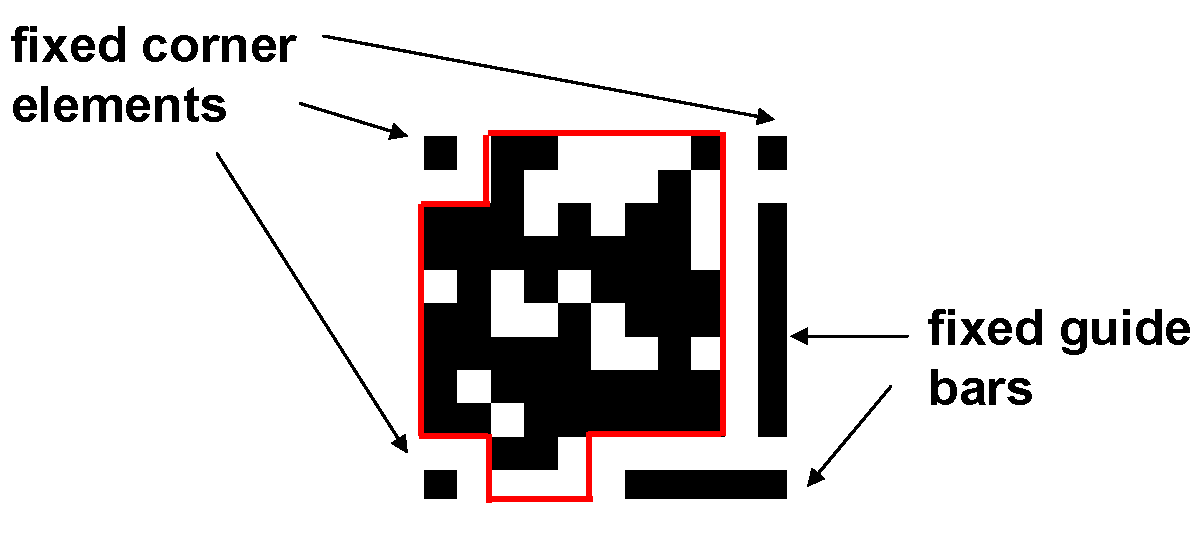
                      
The first stage pre-processing and segmentation aims at transforming the captured image to a binary image to clearly identify the key elements of a visual code marker. The captured 640*480 RGB image is converted to a 640*480 binary image highlighting the key elements such as guide bars and fixed corners in the code marker. Next the image is enhanced to reduce its noise and smoothen it by applying morphological open-close filters which produces a grey scale image. After all the processing in the first stage the resulting will be a binary image which identifies the key element of the code marker. The next stage does a region analysis where each key elements of code marker are localized and grouped. The short and long guide bars are identified first, and then with its properties the fixed corner regions are found. These region analyses are made either based on intrinsic properties or geometric relationship between two regions. 
The registration is for correction for scaling and distortion in the image since it can be taken at a variety of distance and angles. If multiple code markers are present then registration is applied individually for each marker. After obtaining all the bit locations the last stage reads data bits from each grey-scale sub-image. Histogram equalization is applied to the grey-scale image obtain maximum contrast between 1- and 0- valued bits. Bit values are determined by applying threshold at the estimated bit centres. Thus the algorithm is invariant to scaling, rotation and blurring caused due to the device mobility. It is implemented in c and takes approximately 100ms to execute per image using a pentium4 3.40GHz computer.
Download this project in a Pdf format for your reference here: http://goo.gl/Fp6U7

Reduced size antennas for mobiles :Full project report


This thesis aims at designing reduced size of the antennas elements which when used with an RF transceiver adapts with the radiation pattern and ensures better communication between master and slave mobile computers. In order to obtain a maximum efficiency, the project concentrate only on the antenna elements which is suitable to work in the bandwidth range of 2.45Ghz.the choice of the band is based on the fact that it is an ISM band which does not require permission for performing any experimental tests, another reason is that the antenna can be integrated to work with any standard communication devices that operate in this band such as IEEE802.11b standard and Bluetooth. Another advantage is that the Bluetooth modules and its associated w softwares are available in market by many manufactures at affordable prices so it becomes easy for any final year student to pursue this thesis.
From the last ten years we are being witnessing the rapid development of wireless communication which was possible mainly due to the advancements in the field of digital communication. This led to the transformation of the technology into many fields from military field. Since the digital communication had many advantages like resistance with noise and interference etc and better security with encoding techniques, makes it special unlike its analogue counterpart. These features assisted the rapid growth of the 2nd and 3rd generations of cellular phone systems.

Reduced size antenna: Completed engineering project report
The tremendous success of the cellular voice communication has led to the interest of using the radio communication technologies into other fields like wireless communication. Initially wireless computing was a process of inter linking computer and other devices sans wire and making it to perform all the operations like accessing, storing etc that was originally done by the devices using the wire, for example accessing the internet using a wireless acesspoint in places like hospitals universities etc, for the purpose of providing communication between the computers different part of electromagnetic spectrum can be used for transmission over the air, example Infra red radiations and light frequencies can be used but for using them there must not be any obstacles in between the line of site but this is only possible in indoors within less than 1 meter. laser communication also encounters the same problem even though it can be established over several kilometres, for achieving a non line of site communication we can make use of lower range electromagnetic spectrum  namely radio frequencies. An application of a particular radio frequency band depends on specifications of the communication range and the bandwidth of the information-carrying signal. Lower range of radio frequencies is able to cover larger distances. However, this is at the expense of a narrower bandwidth for the signal carrying the message. Which was a disadvantage another shortcoming was the size of the antennas which was required for the launch of the radio signal from RF circuit in to the free space.

For a traditional antenna to work efficiently its size must be half of the free space wavelength so for 1Ghz the antenna must be 15 cms but apparently for microwaves and millimetre waves utilizing  more than or above 1Ghz can offer a reduction in the size of the material radiating. The same frequencies can also offer substantial bandwidth for the information-carrying signal. For example, if it is assumed that a radio transducer operates over a 10% bandwidth, a 100MHz BW for a 1GHz carrier frequency system is theoretically obtainable.

The design and usage of the wireless computers needs a specific frequency band available for it. Everybody knows that the Radio Frequency spectrum is not a free commodity and it’s being governed by specific bodies to avoid its interference by irresponsible users. The other reason is that particular frequency bands can be allocated to specific services. Due to the importance of some offered services, a given frequency band, treated as commodity, may be worth of billions of dollars when auctioned by a government to competing bidders (companies).

Download this final project report on this link: http://goo.gl/aT9l8

ECE / CSE Projects: Smart phones as computer’s remote control.


This project is all about converting your smartphone into the remote of your computer wirelessly. There exist several situations where we want to wirelessly and comfortably operate a computer, where the computer screen is projected onto a big screen through a projector or big-screen television, such as classrooms, conference/meeting rooms, mobile, workgroup project environments and modern office environments, and even living rooms This project will eliminate most of the discomforts we experience in places like conference rooms class rooms and in places where presentations are given by projecting computers.

ECE, CSE engineering projects The main idea behind this system is that it makes use of the smartphone as the mouse of the computer being projected though there are several specifically designed devices are available on the market for the purpose of operating computers remotely and wirelessly. Wireless keyboard, uses either Bluetooth or wireless USB mini-receiver plugged into the USB port of computer for the communication between the keyboard and the computer. Some wireless keyboards have a touchpad for controlling the mouse cursor. Wireless presentation controller, allows user to operate his/her computer remotely for PowerPoint presentation through Bluetooth connection. It usually has several buttons, including mouse-left, mouse-right, next slide and previous slide buttons (for PPT presentation), and even a small size rectangle touchpad for moving mouse cursor. However, all those devices have certain drawbacks. Wireless keyboard has limited flexibility and is not Manuscript received June 2, 2012; revised July 1, 2012.

Whereas wireless presentation controller ensures its convenient for the presenter to carry around the place while presenting, which is not in the case of a wireless keyboard, apart from that it also doesn’t allow the presenter to have a complete control of the computer where as this device does have good mobility allow user to have full operation on the computer, such as running a program, moving or closing an application window, etc. Even it has a small touchpad for moving mouse cursor however it is very difficult for the presenter to use it to move the mouse cursor while he/she is walking around.

There is also a draw back with such devices where we can connect only one such device to the computer if suppose the session is an interactive one and the audience also want to connect to the computer to ask question means it’s not possible. This imposes inconvenience when a group of people, such as a project team or a company internal meeting attendees, are having discussion and need to interact with each other through the same computer with its screen projected onto a wall.

The widely used and very popular smart devices, such as iPad, smartphones, PDAs, and smart game controllers, can be the excellent alternatives as computer remote controllers if we develop appropriate apps for them. For example, Yang and Li developed a system to use WiiRemote, Wiimote in short, to remotely operate a computer, where Wiimote communicates with the computer through Bluetooth. B. Koo etc. proposed a framework of using smartphones to control consumer electronics. C. Wingrave and others provided an excellent tutorial on how to use a smart device, Nintendo Wii Remote (Wiimote) in 3D User Interface systems. Generally speaking, smart devices are digital, active, computer networked, and user reconfigurable devices that can operate to some extent autonomously. These devices usually have the many unique characteristics, such as

Small physical size for excellent mobility. They are designed for handholding and carrying around. They are owned and operated by individuals.
Good Human-Computer-Interface. They have a small touch screen, a build-in physical keyboard or soft keyboard, and run a simplified modern operating system with good graphics user interface. Strong network capability, such as Wi-Fi wireless and Bluetooth allowing Internet access.

Download this complete project details in PDF format here: http://goo.gl/LQU2s

Play chess in real time against opponents anywhere in the world, virtually!


Everybody knows chess was a game which originated in India before even 6th century symbolising two kingdoms fighting each other with all the four armies though it’s an interesting game it can’t be played anywhere, to overcome this problem there has been an project proposing to play chess anywhere with anyone in any part of the world with only internet connection.

The project is been named as “remote chess” and as already said it allows you play chess in real time against opponents anywhere in the world so long as there is an internet connection, and all that it requires is a Remote Chess chessboard, a NTSC television, and a computer running Mat lab, since chess is an open domain this project doesn’t have any trademarks associated with it.

The over view of the project can be summarized as the project’s goal was to create a pair of chess boards for playing remote chess. These chessboards had to detect the movement of pieces and transmit data regarding those moves to each other. The transmission is sent using a serial connection which makes use of the serial ports. The range of this connection is extended through a Mat lab script bridging the serial ports of two Computers which are connected to each other over the Internet.


Now to know how this really works is that, for our chess board to function they needed to perform four separate tasks: scan each tile of the board for the presence or absence of a piece, compare this with previous values, communicate with the other board, and communicate with the user.

The user interface of the project, the user’s input is as simple as moving his pieces on the board. Previous final projects have determined that moving pieces automatically is difficult and inaccurate; therefore this project allows the users to move the pieces themselves. The opponent’s moves are shown with a graphical representation on a TV screen. Since the player can see where his opponent has moved pieces by looking at the TV screen, he does not need to have his opponent’s pieces on his board. So once this project get to be implemented practically everyone can gets a chance to play chess anywhere and anytime.

Engineering project (ECE) : RFID in billing products.


Title: RFID check out at shopping malls.
Departments: ECE, Telecommunication, Communication engineering.
Can be used for: Practical purposes, application in stores, engineering projects.

About the project:
This material is originally from here. This project about development of a new and unique idea. We all have faced this problem in big shopping malls and stores where we all normally go for home needs or clothing. Being consumers, we all must have the experience of standing in long queue for getting our bills paid. ( Yes! i am talking about that same irritating moment.) So, here are two intelligent engineering students Jigar Shah and Kevin Yang. Helping us to change the trend with the help of their engineering and tech skills. They have built an simple yet powerful tool with RFID concept to resolve this problem! claiming that this system will help customers pay their bills just upon arrival to the billing counters, increase in satisfaction quotient and more.

The way today's super markets/ stores and billing counters working is on the barcode scanner. The customer will have to take her products to the counter, where a person will scan the bar codes and do the billings. this is traditional and this old. According to this project the products are scanned and billed with RFID concept! This project utilizes these RFID tags to automate the checkout process by building a system which will read all product's tags signals (RFID) which will be placed in close to the antenna coverage. This will have a very positive impact on the cost management, security and reduce human errors.

Credits: Jigar Shah and Kevin Yang.

Download this project and you 
can use this for education purposes: http://goo.gl/CBU3E

Networking projects for engineering students: Performance analysis of Wireless local area networks.

Title: Performance analysis of Wireless local area networks.
Departments: Computer science engineering (CSE projects), Information technology, Communication engineering. 
Can be used for: Analyze wireless networks, Final year engineering projects, paper presentations.

This project titled "Performance analysis of wireless local area network" is a simple yet good, interesting and challenging project for all the engineering students, who are interesting in wireless communication or networking papers. Setting up a wireless network is so simple these days. Very common person will be able to do that, with the help of the new features available today. But analyzing the performance of the working network is something so interesting and important in the infrastructure level. In a wireless network, An access point is the main authority which controls all the traffic and members of the network. AP can add or remove a node from the existing network. So thus setting up a network aloe wont let the network work with 100% efficiency. The performance checks has to be performed in order to check the collisions and packet drops in the network.


Sample from the below attached networking project: There have been many developments in the field of networking in past decade but the most important one was the development of wireless networks that provides ease of feasibility to roam around. Wireless networks have been given a lot of attention because of its flexible nature in the data communication systems. It has been implemented as an extension or as an alternative of wired networks, which can be deployed virtually anywhere; from offices to university campus or providing hotspots at the airports, cafes, etc. Besides having many advantages, wireless networks have some limitations as well which are generally due to the underlying medium being used. These limitations involve mobility, fewer battery life, frequent collisions and limited bandwidth. Such factors degrade the overall network performance. Many researchers have tried to increase the performance. To achieve this, many models were proposed to improve the performance by increasing the throughput and decreasing the delay, especially in a dense environment. Few of them achieved the desirable performance metrics with low delay and high throughput but most of them lack these desirable performance metrics.

Download this final year engineering project with papers
Performance analysis of Wireless local area networks here : http://goo.gl/570r4

Final year projects: bandwidth allocation methods in optical networks, Networking project.


Title: A survey on bandwidth allocation methods in optical networks, Networking project.
Departments: Communication engineering, Electronics and communication engineering (ECE projects), Computer science engineering (CSE projects), Networking projects.
Can be used for: Final year engineering projects, engineering projects, networking projects, paper presentation.

Networking projects are really of great demand in todays project markets. This scenario of demand was not created by any artificial source. The natural tendency of the present engineering students towards the subject of networking, has made this demand. Doing a project in networking is sometimes easy and other times head breaking. So students who are willing to take up projects in networking please be careful. Well, this project is for the students who are still searching of a good topic in networking for their final year engineering projects. About this project, Nowadays optical networks are domination the other technologies like Ethernet. Mainly due to increase in the usage data. At this time allocating bandwidth properly to the networks is an important task. A detailed understanding and evaluating the performance of networking protocols is very much important. In this context this projects is n best choice. All the best, use the paper attached below.

Sample from the below attached networking project: The protocols Asynchronous Transfer Mode (ATM) and Ethernet have been recommended as the transmission protocol in PONs. In these years for this reason that the EPONs are flexible they have gained more attention from the industry. The architecture of an Ethernet network is simple yet highly operative. The ability of work between old and new networks can easily be support and inheritance solutions can be used as EPON data is coming in standard Ethernet frames. Naturally the EPON networks are accept in a tree topology with multiple ONUs that is linked to a OLT as a splitters. There are two type of transmission that I show in Fig1, Fig2. In a downstream transmission (Fig1) the OLT uses all bandwidth to broadcast packets through the splitter to each ONU. Each ONU excerpt packets by check the Medium Access Control (MAC) address in packets.

Download this networking project details
Bandwidth allocation methods in optical networks here: http://goo.gl/xcdcs

BE projects: ECE final year engineering projects, (With ready 100 pages of final report)

Title:  Reduced size of antennas for mobile phones
Departement: Communication engineering, electronics engineering.
Can be used for: Final year ece projects, engineering projects for communication engineering students.

This project on antenna technology is a good choice for all the electronics and communication engineering students. Antenna is one of the most basic component of every communication unit. This antenna play a very important role in proper communication field. Though an antenna is just a piece of metal that is used to transmit the signals into the air, the work it does is phenomenal. In early days the size of the antenna was never an issue, all the users were ready to allot a space of the aerial either over the terrace or the open balcony. But these days the size plays a big role due to the new compact communication devices (Mobile phones). The smaller the device is the better market is has. So the technology has to meet the needs. Thus the researches were started to develop the smaller antennas for the mobile computing devices. This engineering project is easy to implement and also has a ready made Project report of about 100 pages attached at the bottom. 


Sample from the antenna designing project: frequencies requires a free-of obstacles space between a transmitter and a receiver. In practice, such line-of-sight conditions for a mobile environment occur only over very short distances (in the order of 1 meter). This explains why IR devices are mostly used in indoor environments. In addition, laser communication over several kilometres can also be accomplished. However, similarly, as IR, this requires free of obstacles pathway between a transmitter and a receiver and a very subtle alignment of the two being at stationary positions. In order to achieve a non-line of sight communication, a lower range of electromagnetic spectrum, namely radio frequencies can be used. An application of a particular radio frequency band depends on specifications of the communication range and the bandwidth of the information-carrying signal. Lower range of radio frequencies is able to cover larger distances. However, this is at the expense of a narrower bandwidth for the signal carrying the message. This is viewed as a disadvantage. Other shortcomings of low RF frequencies are associated with the size of antennas, which are required to launch a radio signal from an RF circuit into a free space. In order for a traditional antenna (such as a dipole antenna) to function efficiently, its size needs to be about half free-space wavelength. As at the frequency of 1GHz, the free space half-wavelength corresponds to 15cm, it becomes apparent that microwaves and millimetre-waves, utilizing the frequency spectrum above 1GHz (with free space wavelength smaller than 30cm), can offer a reduction in size of radiating elements. The same frequencies can also offer substantial bandwidth for the information-carrying signal. For example, if it is assumed that a radio transducer operates over a 10% bandwidth, a 100MHz.

Download this final year ECE project details

Here is the attachment of the final report of the mentioned project: http://goo.gl/sJAV4

Image compression projects: digital image processing (ECE, CSE projects)


Title: Fast Block-Pruned 4x4 DTTAlgorithm for Image Compression.
Department: Computer science engineering, Communication engineering, electrical engineering, Digital image processing, Digital signal processing.
Can be used for: Final year engineering projects, paper presentations, research works.

Finding image compression and digital image processing project topics for your final year engineering projects can be so easy and simple. Because of the development in the trend of "project centers" and guides. Still this project on digital image compression is valuable because this is more real and latest trend in the topic that you will not find in the lists of your project centers. The most interesting fact about the DIP projects is, This topic is one of the common topics that is open to all the departments of engineering (probably). This is due the application and demand for this concept. The image compression is done to send the large sized original image through the internet to a remote place. As sending such large data through the internet is not practically possible, we need image compression and processing.

Sample from this image compression / processing project: In this paper, a fast 4x4 algorithm which is suitable for different block-pruning sizes is proposed. The rest of the paper is organized as follows. Section II introduces the definition and the properties of the DTT algorithm and its 4x4 version. The proposed fast block-pruning 4x4 DTT algorithm is presented in Section III. In Section IV, the computation complexity of the proposed algorithm is illustrated with respect to different block-pruning sizes. As well as, the computation complexity of the proposed algorithm is compared with those of others. Section V demonstrates the reconstruction of different standard images using the pruned 2-D DTT vs. the pruned 2-D DCT. Finally, the conclusion is given in Section VI.

Download this final year engineering project details 
Here is the final attachment of the "Image compression / processing" project details: http://goo.gl/C7Czn

Antenna designing projects: Final year ECE projects (Rare collection)

Title: Antenna designing project (Long distance Wi-Fi signals BI Quad dish antenna)
Departments: ECE projects, communication engineering. 
Can be used for: Antenna study purposes, Final year engineering projects, ECE projects.

The antenna designing projects are an apt choice for students of electronics and communication department. This project involves both designing an perfect antenna for a particular frequency and testing the efficiency of the designed antenna. The antenna in basically an device that is used to transmit or receive any desired signal that in available in the space around. We all know that antenna are one basic component that are used in every modren communication equipment. Doing a project on this field will give you a better understanding in the communication and signal concepts. the construction of this project will not cost much. Most part of this project can be constructed with the junk parts.

Sample topics covered: RF Basics Frequency, bands and bandwidth ,Wavelength ,Amplitude and power ,Decibels and dB math ,Types of Antennas ,¼ Wavelength Ground Plane ,Yagi antenna ,Horn ,Parabolic Dish ,BiQuad ,Transmission lines: Basics ,Cables ,Practical Hints: How to choose the proper cable, Connectors and Adapters ,proper connector, N Type connector.


Download these Final year engineering project
Long distance transmission antenna designing project details  here: http://goo.gl/WFwlS

ECE project final year : GPS tracking system (on google maps)


Title: Open GPS tracker project details. 
Department: ECE projects, electronics engineering, communication engineering.
Can be used for: Final year engineering projects, Be projects.

This engineering project was posted as a response, for the request from an engineering student, for his final year engineering project. This project will be more suitable for ece students / Electronics and communication engineering students or students who are interested in doing projects in the communication field like Global positioning systems (GPS), tracking system, mobile networks and more. The main advantage in doing this project is because of the easiness in construction. This GPS tracker project post has a very interesting file attached below, where all the necessary information are included! It includes right from the apparatus required to construct the project to the result models.

Sample from the project attachment: Welcome to the Open GPS Tracker site. The Open GPS Tracker is a small device which plugs into a $20 prepaid mobile phone to make a GPS tracker. The Tracker responds to text message commands, detects motion, and sends you its exact position, ready for Google Maps or your mapping software. The Tracker firmware is open source and user-customizable. Project status: Current build is 0.17 assembled 04/24/2008: We currently have second-generation stable firmware and a reference hardware design. All parts are available from Mouser Electronics, and the phone is available from Target, Walmart, or Radio Shack. This site provides the firmware with source code, theory of operation, parts list, and exact assembly and checkout instructions. If you can solder, this is a one-sitting project. No PC board or surface-mount capability is required. The source was electronics-lab.com

Download this ece project details 
GPS tracker project details here: http://adf.ly/45V9B

Aircraft navigation system : Aeronautical engineering projects

Title: Aircraft navigation system projects.
Department: Aeronautical engineering, communication engineering, radar technology.
Can be used for: Study purpose, engineering projects for aeronautical students, paper presentation works.

This is a BE project that has a research paper. This paper was originally invented by Cucius O. Taylor. Mostly students studying aeronautical engineering are planning for their final year projects in designing or modeling. We find not much students who think out of the circle. This particular post on Navigation system will be every innovative and unique for competitions and projects. Because this will deal with radio communication and radar technology also. This will definitely open minds towards various other parts of engineering. So, we highly recon this project for both aero projects and eke projects. The project description: It has a navigation apparatus that will include a radio receiver, with directional antenna, a memory unit to store the location based on reference point around the spot, a processor for processing and analysis. So this set up of the navigation apparatus is connected to a computer at the aircraft. At the remote end there is an antenna to receive the location signals from the aircraft.

Sample of this Aero projects for engineering students: Global positioning systems (GPS) have become nearly ubiquitous as navigational aids, for individual users as well as, more importantly, aviation users. GPS receivers are accurate and relatively inexpensive, and they are also easy to use, because they are area navigation (RNAV) systems. RNAV systems allow navigation on any desired course within the system's area of coverage. In other words, an RNAV user is not limited to following a specific track to or from a radio navigation aid (as a user must with some navigational aids), but can simply plot and follow waypoints that make up an RNAV route. For aircraft navigation, GPS is currently used mainly as a supplemental RNAV system, although there are plans in the United States to make GPS the primary basis for radionavigation by the year 2010. There is a strong economic motivation to use GPS as a primary basis of navigation due to the expense of maintaining land-based navigational aids (navaids) currently in place, such as LORAN, VOR, DME, etc. For critical uses such as aircraft navigation, however, the very low power signals employed by GPS satellites can beacause for concern, especially if GPS is used as a primary basis of navigation, rather than as a backup system for other established navigation systems. Specifically, the extremely low-power GPS signals may be susceptible to jamming or interference due to weather conditions, radio noise, or other sources. This is true even though GPS augmentations such 35 as the Local Area Augmentation System, Wide Area Augmentation System, and other augmentations can improve the accuracy, integrity, and availability of the basic GPS.

Download this be engineering project details

here for your use and reference: http://goo.gl/UeoL7

Engineering projects: Repeaterless fiber optics communication.

Fiber optics engineering project ideas.pngTitle: Repeater less branch powered fiber optic communication.
Departments: Communication, Electronics and electrical, Telecommunication.
Can be used for: Paper presentation and related study.

This is a project that falls under the subject of "FIber optics communication". this papers idea was invented by Lars Erik Eskildsen, Evan Lee Goldstein, Per Bang Hansen. The basics of this paper presentation can be stated in this manner. The title suggests that the engineering project in the fiber optics is to design a network with branches that is repeater less. This idea is to construct a fiber network, configured in the ring topology with number of hubs in the network and one or more branching its interconnected in that. the branching units are designed to add/drop the signals along the path of the network. The engineering projects on fiber optics is to reduce the loss and remove the repeaters still make that network effective with the optical amplifiers.

Sample of this fiber optics project: The specification relates to a repeaterless branch powered fiber optic communications system. The system comprises an optical fiber cable trunk, configured in ring topology, with one or more telecommunications hub, and one or more branching unit serially interconnected therein. Branching units are provided as convenient add/drop points along the extend to cable stations. Cable stations insert and extract telecommunications traffic from the trunk ring over the branch fiber optic cables. In addition, the branch fiber optic cables are also coupled to light emitting power sources. The branch fiber optic cables deliver the energy produced from these power sources to optical amplifiers serially embedded within the branch fiber optic cables, the branching units, or the optical fiber cable trunks. The optical amplifiers convert the energy delivered from the branch fiber optic cables into amplified telecommunications signals. Thus, remote pumping or energy delivery is achieved without the requirement of additional optical fiber cable runs and further, using solely passive repeaterless components.

Download this engineering project here: http://goo.gl/1NJZx

Digital image processing, Engineering projects


Title: Device for performing image processing based on the image attribute.
Department: Computer science, communication engineering, image processing.
Can be used for: Educational presentation, engineering seminars, engineering projects, final year projects and more. 

Image processing projects is one of the hot topics for the students of the departments like computer science and communication. image processing seem so attractive to students basically because of the general nature of this subject. I fount this project on the web which was invented by Tsutomu sakaue. The overview of this project can be given like, This present engineering project on image processing proves an image processing device that evil be able to compress the information volume of attribute data by vectorizing the attribute data. The transmitting device will have a attribute separating unit that will extract the att. data from the original image, a vectorizing unit will vectorize the att. data and transmits the vectorized att. data that was already vectorized by the vectorization processing unit together with the image data .his is receive in the the other end and the data is retrieved by inverting the same process at the receiver end Thus this project works. 

Sample of this research paper on image processing: 1. Field of the Invention: The present invention relates to an image processing device and an imaging processing method for performing image processing based on attribute of an image, as well as a computer-readable medium for performing the image processing method. 2. Description of the Related Art: In recent years, along with the spread of technologies such as intranets and the Internet, it is becoming typical to use image processing devices in an office over a network. For this reason, whereas image processing devices for producing copies have been used as stand-alone devices, it has now become possible to use such devices over a network. In other words, it has become possible to produce copies using different image processing devices over a network 

Download this image processing project here: http://goo.gl/RXYSP

Wireless Vehicle/Automobile security system project

Title: Interactive wireless vehicle security system.
Department: Electronics and communication, Automobile, Networking, computers, security.
Can be used for: Paper presentations, final year projects, research work for students and others.

This projects idea was an inspiration from this paper by Wang Qiahe et al. This paper by him is on the security system for the vehicles via wireless communication. This is one of the projects that most of the young engineers get attracted. This attraction is due to the various number of fields this project cover. subjects like networking, communication, embedded, automobiles and more. This is such an interesting project to work on. The simple working of this projects idea can be stated as following, This has an security system designed that detects intrusive activities in and around a vehicle and transmits the message (warning message). the speciality about this project is that, it also adds specific description of the warning in the same message through a wireless telephone network to the administrator or the owner's assigned contact. So that in response that message the admin or the contact will be able to establish a remote wireless communication with the security system and get further information.

Sample of this paper presentation / engineering project: The CPU can also be programmed to take other actions automatically, through the GSM module and/or the vehicle control interface, in response to specific intrusion indicators. For example, in response to intrusion sensors indicating vehicle vibration or movement in the vehicle's vicinity, the CPU can send a command through the vehicle control interface to lock the doors and sound the vehicle's horn or alarm siren. If one of the intrusion sensors indicates that the vehicle has been tilted, on the other hand, the CPU can be programmed to select from the message ROM the message that the vehicle is being towed away by a thief and to transmit that message through the communication interface to the GSM module, with direction that it be sent to police and emergency telephone numbers. And in response to a pressure reading from the gas pedal sensor, the CPU can be programmed to send a command through the vehicle control interface to disable the fuel pump so that fuel will stop flowing to the engine.

When the owner receives a message from the base unit specifying the type of intrusion and time of occurrence, he or she can initiate a number of responsive actions from the keypad, from a remote telephone, or, if supported by the local GSM service provider, from a computer or PDA. When the owner contacts the base unit through the GSM module, he or she can access the CPU by entering a pre-programmed password. Password authentication causes the CPU to access the menu ROM containing a series of digital voice instructions and menu prompts eliciting alternate choices. The menu prompts begin with the most general main menu level and progress to more specific sub-menus based on the owner's responses. The menu prompts are transmitted through the communication interface to the GSM module and from there to the owner.

Home automation security project (complete paper)


Title: Home automation security system project.
Department: Computer science, Automation, Networking, Communication.
Can be used for: To improve ideas in automation projects, develop home security projects and research papers, paper presentations.

This engineering project is an patent by Thomas J. Hackman et al. This paper will provide you with the details of the titled project. The topic of automation and security is in top notch in the research field. For those students who are interested in this topic "Automation projects" this paper will be very useful. To explain this paper in simple words, the projects is developed for home and office purposes. A computer network controlled and monitored automation system in which a residential server controls and monitors security and other computer controllable systems in the same house/office. 

Sample of this paper presentation / engineering project: A network overview of a current industry standard for Web control of a home automation system. Such prior-art home automation systems place a Web server in each of the homes that remote users can directly connect to outside of the home, such as, for example, via a laptop while traveling or via a PC while at work. To access the user's home automation system, the remote user simply 'surfs' directly to a Web server that is located in the home. This Web server is usually directly connected to the Internet and very exposed to hackers. For example, the data connections shown in FIG. 1 are all established via plain text HTTP requests (unencrypted). A primary disadvantage with this prior-art system is that a Web server directly connected to the Internet is often exposed to hackers. If proper precautions are taken, the risk to someone hacking into the home can be minimized but not eliminated. The home is an attractive target to hackers for many obvious reasons. The most common vulnerabilities to the systems that are sought after are flaws in the operating system, Web server or ancillary services. Operating system manufacturers are constantly releasing patches to repair recently discovered security flaws or to stop newly invented hacking tools. Corporations usually have someone on their IT staff actively monitoring their servers, installing all of the latest security patches, and reacting to stop intrusions. Homeowners, on the other hand, will unlikely have the technical background to perform this task, and a system initially intended to make their life easier should not place this type of burden upon them.

Download this engineering project / Paper presentation here: http://goo.gl/ndRZa

GPRS Driving WAP on the road to 3G

ABSRTACT
Mobile telephony allowed us to talk on the move. The Internet turned raw data into helpful services that people found easy to use. Now, these two technologies are converging to create third generation mobile services. In simple terms, third generation (3G) services combine high-speed mobile access with Internet Protocol (IP)-based services. But this doesn’t just mean fast mobile connection to the world wide web. Rather, it means whole new ways to communicate, access information, conduct business, learn, and be entertained -- liberated from slow, cumbersome equipment and immovable points of access. Mobile computing is being heralded as the new “killer app” for the Internet.
While 3G hasn’t arrived yet 2.5G is here! The technologies at the forefront of 2.5G push are GPRS (General Packet Radio Service), EDGE (Enhanced Data rates for Global Evolution.), WCDMA (Wideband Code Division Multiple Access), and WAP (Wireless Application Protocol).

Radio frequency identification : BE project / Paper presentation


The radio frequency identification is an developing technology in the communication and tracking industries. According to the wiki, "This technology uses the radio waves to transfer from an electronic tag called the radio frequency identification tag, which is attached to the objects, used to track the object."

Engineering projects for communication engineering students. This projects is an patent paper, that can be used by students for educational purpose. The BE / B.tech projects done by engineering students need to be innovative and trending. engineering students who wish to do their projects in the Communication, Radio frequency, transmission, tracking sectors can select this as a project. Being this project has been implemented real time, it can also be used for communication paper presentation for competitions. 

The titles of the below listed RFID engineering projects are:
  1. Radio frequency identification
  2. Radio frequency identification (RFID) system
Download this paper-presentations/BE project : 

Digital signal processing using smart biometric solutions


Abstract of this paper-presentations : (Digital signal processing using smart biometric solutions)
       Biometrics is the science of measuring and statistically analyzing biological data. In information technology, biometrics refers to the use of a person’s biological characteristics for personal identification and authentication. Fingerprint, iris-scan, retinal-scan, voiceprint, signature, handprint and facial features are some of the most common types of human biometrics.

Digital signal processors (DSPs), which are specially designed single-chip digital microcomputers that process electrical signals generated by electronic sensors (e.g., cameras, fingerprint sensors, microphones, etc.), will help to revolutionize this world of biometrics. The core of the biometric authentication process is made up of image processing and pattern matching or minutiae comparison algorithms. And the programmable DSP, with an architecture well-suited for implementing complex mathematical algorithms, can efficiently address all the processing needs of such a system.

The following information introduces the concept of a complete biometrics system solution based on semiconductor components, development tools, and software solutions. Additionally, the various concepts that outline the inherent advantages of a DSP in a biometric system - better accuracy, faster recognition and lower cost, all leading to
smarter biometrics - will also be covered.


Paper presentations : Fiber optics communication

About this communication paper presentations : (Fiber optics) 
       Fiber optics is one of the well developed communication medium, Though this fiber optics communication is an important paper in the engineering syllabus the basics of these subjects were been studied and understood during our high schools. the concept is very important for the communication engineering students. Even though the fiber optics communication is a wired mode of data transfer while the world is moving with the wireless, it is still famous because of the amount of data it could transport in a short time with unimaginable speed and least loss possible. this  optical communication cables use light as source of data so because of this is will escape the external field losses and more. Initially this type of cables were been used to connect major international networks but in later times these cables are used from a small town network to a home setup for improving the efficiency and bandwidth of the network. This can also be blamed for one of the main reasons for high speed internet access that we enjoy today. Using these kind of paper presentation in the classes can be highly effective for a seminar and internals. If you are planning to use this paper presentation for a higher level events, we would like to advice you to take up the issue seriously and do some research about the trend and improved technology on this topic fiber optics communication. You can also make use of our Request any new paper presentation form to apply.


Fiber optics paper presentation
Fiber optics paper presentations
Sample of the fiber optics paper presentations : The best way to describe the current technology being deployed is to provide a brief case study of a company that extensively uses optical fibers. I have chosen Energies PLC, a British Company that is currently expanding its network throughout Europe. 

Their network exclusively uses single-mode optical fibers. Partly due to their commercial history a large number of their fiber cables are installed on lines belonging to the National Grid Company and to some regional electricity companies. They also use cables buried in ducts under roads and pavements. 
They use DWDM (some uni-directional and some bi-directional) with 10Gbit/sec on each of 4 wavelengths. They are currently introducing 32 wavelength systems, and will inevitably introduce 40 Gbit/sec-per-wavelength systems in the near future. 

Their optical repeaters (for which they use EDFAs) are typically spaced at around 80km and their regenerators can be up to 600km apart, although this is partially dependent on previous repeater locations. New technologies that are emerging will theoretically increase the regenerator spacing to 5000km (and even further with the introduction of soliton transmission), although DWDM does reduce the allowed distance between amplifiers and regenerators. 

Download this paper presentation here: 

Intense Debate Comments